Here’s the secret to family photos: a short list, written down, in an order that keeps people moving. And a kind list, one that reflects the family you actually have, which isn’t always the one on the invitation. Neither is hard to build once you know the order that works.
First, a little comfort. Among the couples who filled in our planning questionnaire this year, 38% mentioned a complicated family relationship. Divorce was the most common, at 22%. Another 9% said their parents get along fine despite a divorce, and 6% described real conflict. So if your family is complicated, you’re in very good company. You’re in the majority of the couples we meet, not the exception.
Below is the list we actually use, how we bend it for real families, and how to word it so the day stays calm.
So who’s actually on the family photo list?
Most family photo lists start the same way: the parents, the grandparents, the brothers and sisters, and anyone married to those people. Stick to that and we can almost always finish the family photos in 15 minutes. You can add other groupings and we’re glad to do them, but each one past the standard set adds time, and we’d just like you to know that going in.
Start with these. They cover most weddings, and each one is a separate grouping we can photograph in about a minute once everyone’s standing in place. That’s our own planning figure, not a universal rule, but it’s held up well for us.
- Couple with her parents
- Couple with his parents
- Couple with both sets of parents together (only if everyone is comfortable)
- Couple with her extended family, if they are in the formal portraits
- Couple with his extended family, if they are in the formal portraits
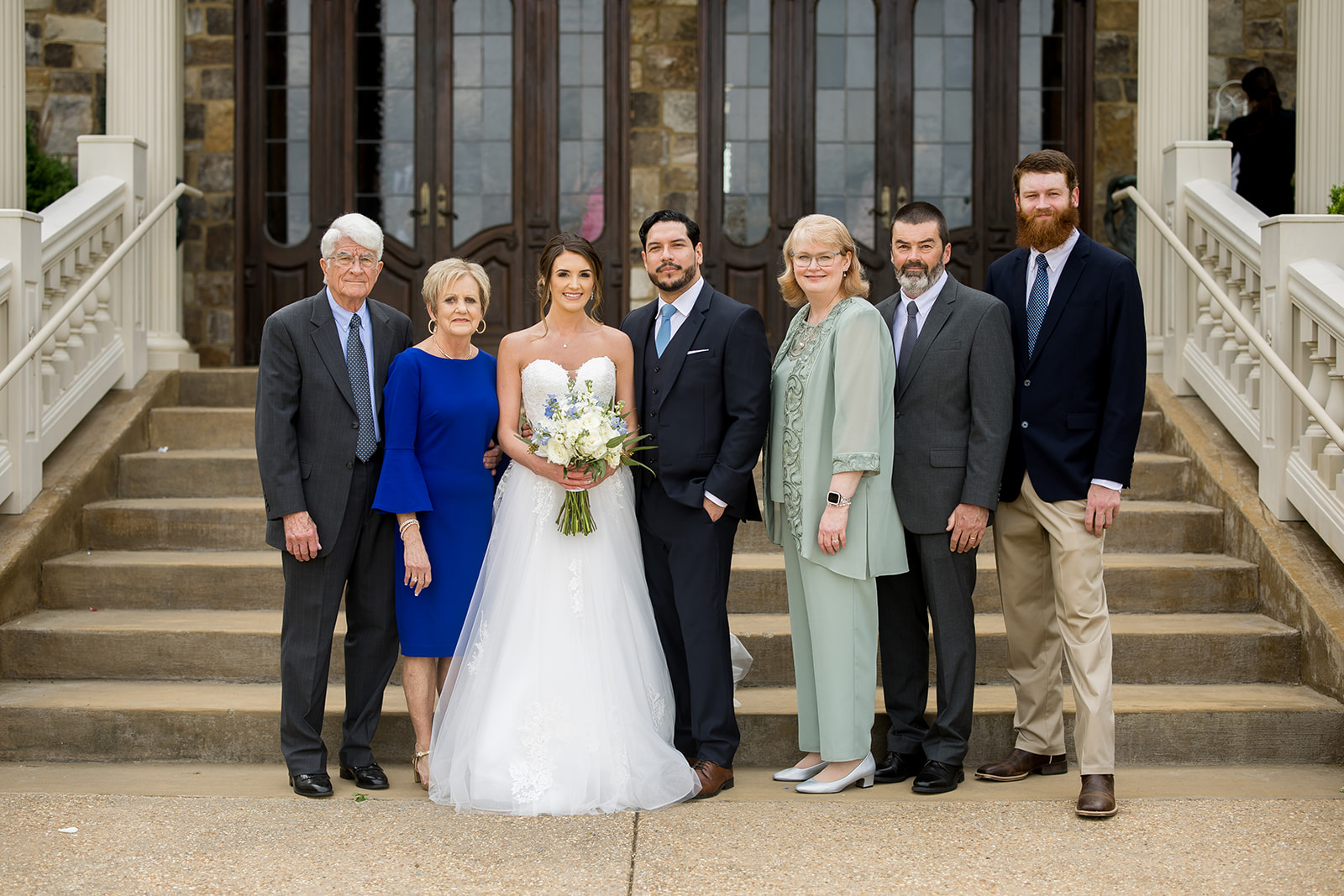
- Couple with her immediate family, including siblings and their spouses
- Couple with his immediate family, including siblings and their spouses
- Couple with her grandparents
- Couple with his grandparents
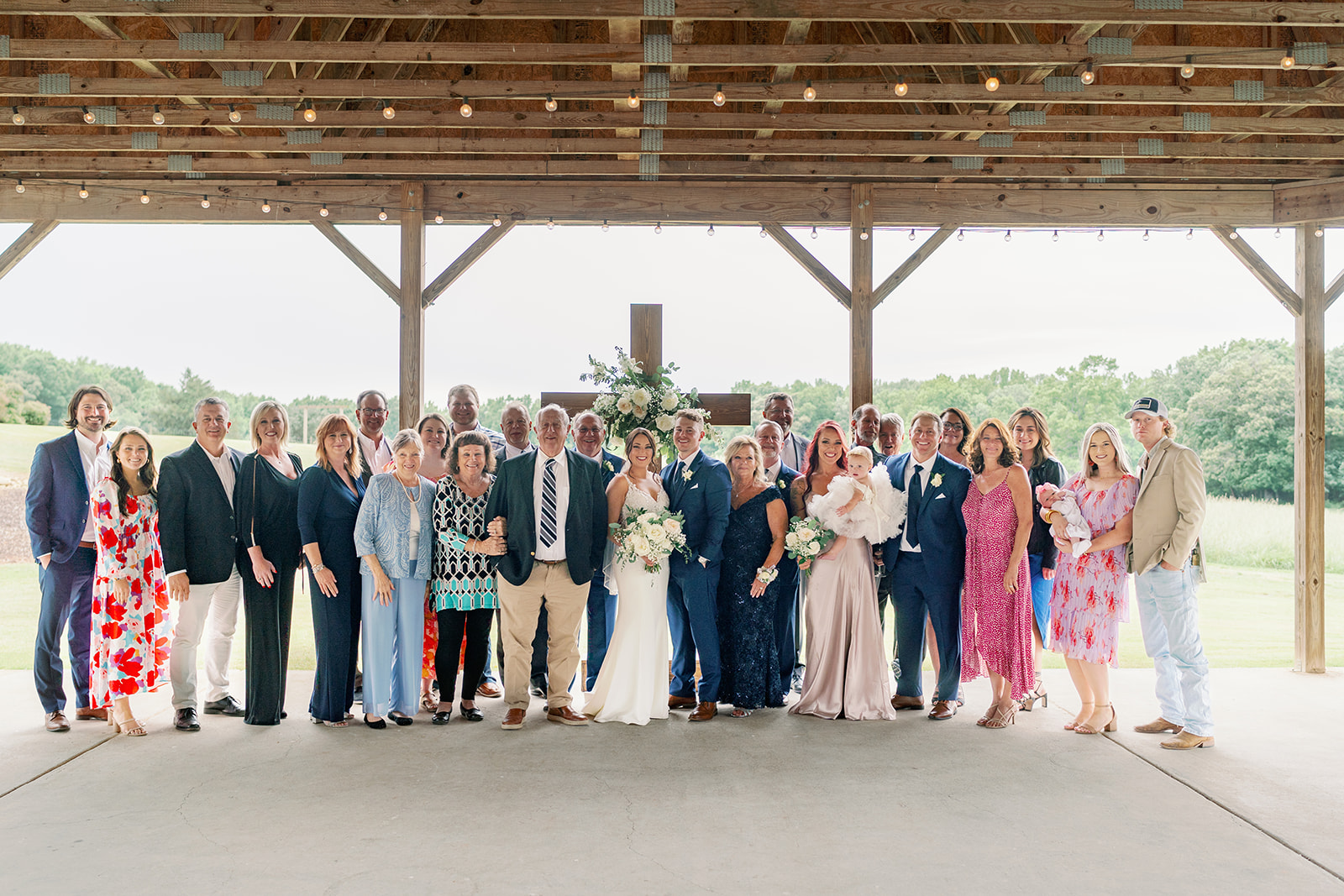
- Couple with both families together, if the group is manageable
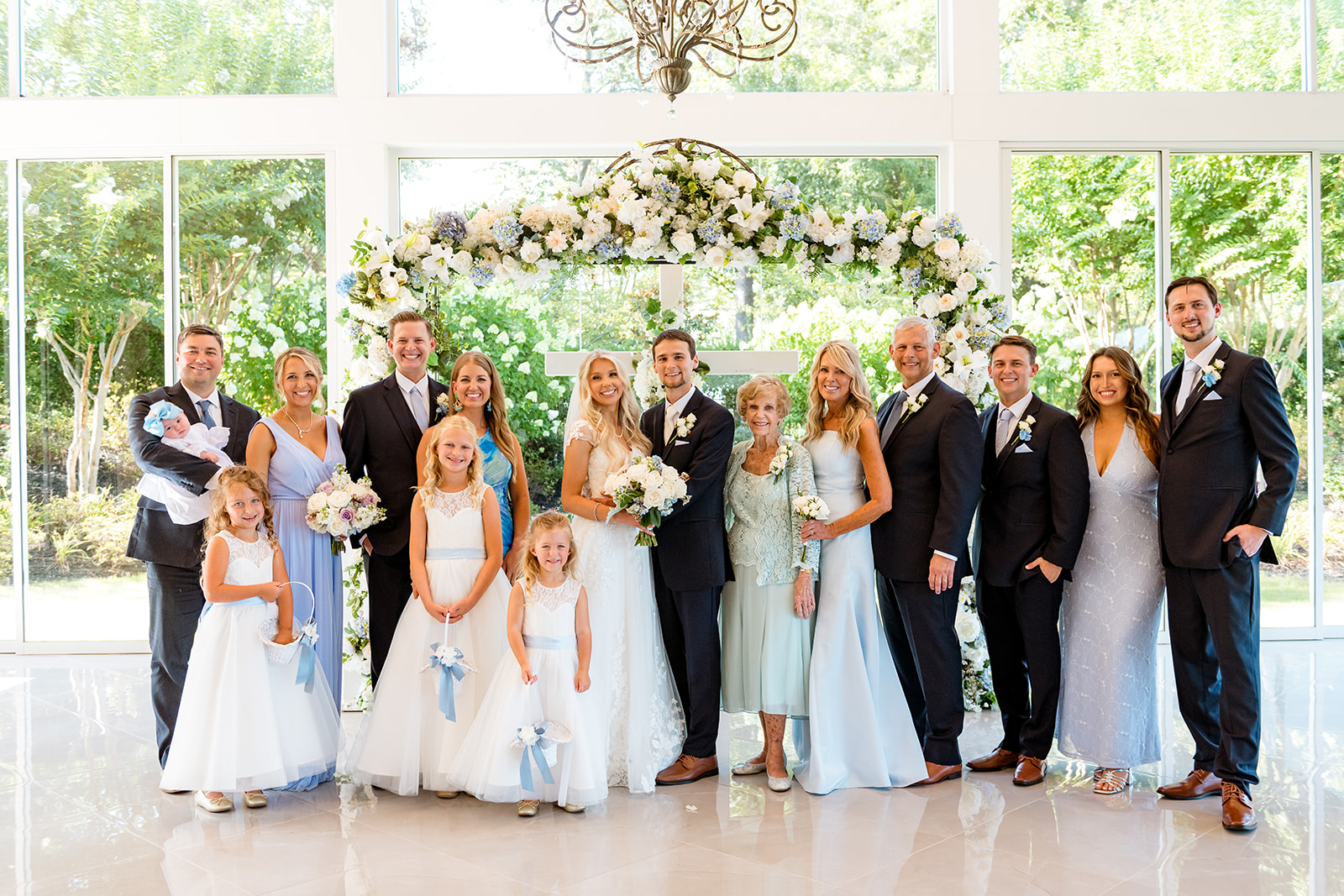
- Couple with the wedding party
- Couple with the flower girl, ring bearer or other children
- Couple with any person who played a special role, such as an officiant or a close family friend
That’s 13 groupings, or roughly 13 minutes of photographing. Add a couple of your own, plus a 5 to 10 minute buffer for rounding people up, and you land where most of our family photos do: 10 to 20 minutes in total. We suggest stopping near 15 groupings.
Why the order matters more than you’d think
Here’s something that surprises people: we go from the biggest group to the smallest and never change it, because every time someone wanders off and comes back, it costs a minute.
We start with the largest group on one side, then peel people away. Each person we release heads back to the party while the circle around you gets smaller. That’s why extended family comes near the beginning if you want them in the formal portraits: they belong in the big group, not the small ones with just you and your parents. Working big to small also lets the grandparents go sit down quickly, and the children come early, before they run out of patience.
What about divorced and remarried parents?
This is the part most couples lose sleep over, so it’s where a list really earns its keep. Here’s what has worked well for the couples we photograph.
- Give each parent their own grouping. Mom with you, Dad with you, and a separate grouping for each stepparent or partner if you want one. Don’t assume the parents will want to stand together.
- Ask each parent privately. A short question works: “Is there a photo you would like to have of the day?” Their answers go on your list, and nobody’s surprised on the day.
- Never force a joint photo. If both parents are happy to stand with you, wonderful. If not, a photo for each is a complete answer.
- Decide who stands where in advance. Parents can sit or stand on either side of you, not necessarily next to each other. Tell us the arrangement and we’ll place people accordingly.
- Keep tension off the schedule. If two groups can’t be near each other, space them out and we’ll call them at different times.
In our planning questionnaires, 31% of parents had specific expectations, and most of those, 26%, were about family groupings. Often there’s one grouping they care about most. Find out which one, put it on the list, and you’ll head off most of the trouble.
How to word it for your photographer
Write the list as groupings, with the first names of everyone in each group. We call each group by first name on the day, so “Couple with Linda and Mark” works better for us than “mother and her significant other.” Where a role helps, add it: “Couple with Mom (Linda) and Mom’s partner (Mark)” reads more clearly than “mother and her significant other.” A one-line note is fine too, like “Please photograph Dad and Stepmom separately from Mom.” We read the list as written, we don’t comment on it, and we won’t ask anyone to explain.
Where do stepparents and partners fit?
If stepparents and parents’ partners are part of your life, they belong on the list, and nobody should feel like an afterthought. Give them a separate grouping rather than adding them to a photo where someone else might feel awkward. When in doubt, ask the parent whose partner it is, then ask the partner too.
A family photo list isn’t a verdict on your family. It’s a plan so the people you love aren’t standing in the sun waiting.
One person in charge per side
Here’s the single best trick we know: give us one name per side of the family, a sibling or a cousin who knows everyone by sight. That person gathers the next group while we’re photographing the current one. The minute the ceremony ends, everybody wants a hug and a drink, so somebody has to be the friendly one holding the list.
In our post-wedding notes from 2024 to 2026, 44 of 212 weddings had some kind of family-photo issue. In 24 of them, the photographer re-confirmed the list on the day. In 4, there was no list at all. And 15 weddings had very long lists. A written list, an organizer per side, and a cap near 15 groupings cover most of that.
Bring a printed copy of the list on the day. You won’t need a microphone or any shouting. We call each group by first name, which is why we ask for first names on the list, and the organizer finds them. People tend to answer a quiet name better than a loud announcement.
Where the family photos fit in your day
We almost always do the family photos right after the ceremony, with or without a first look, because that’s the one moment everyone’s standing in the same place. A first look still helps: the wedding party photos are done before the ceremony, so afterwards we only need the family groupings, one big photo of the two of you with the whole wedding party, and then your own portraits. Sometimes we knock out a grouping or two early, but we plan for the family right after the ceremony. Our timeline for a 4 PM ceremony shows both versions, and you can read it at /blog/wedding-timeline-for-a-4pm-ceremony.
A couple of things we ask for:
- Wedding party photos before the ceremony should finish about half an hour before it starts.
- Family photos after the ceremony take 10 to 20 minutes, so plan cocktail hour around them and you’ll still get your own portraits.
- Every family member on the list should be at the site, dressed and ready, at the call time.
Picking the spot: location, light and mobility
The spot matters nearly as much as the list. We look for open shade or even light, and a clean backdrop with nothing growing out of anyone’s head. Good venues often have a ready-made spot, like an arch, a set of steps or a pavilion. Our guide to The Tate House shows the kinds of spots we have to work with there.
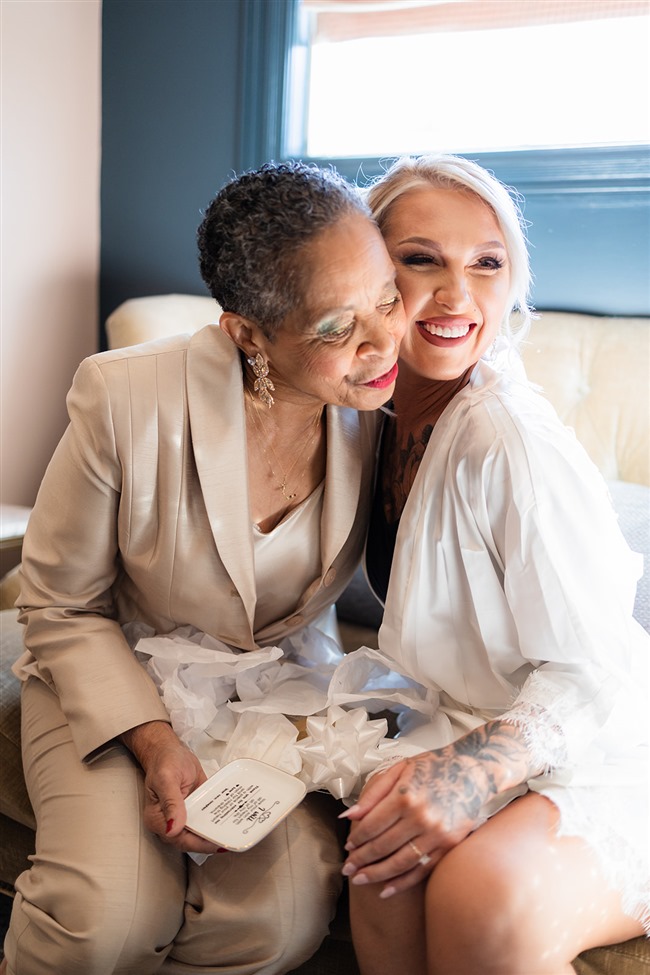
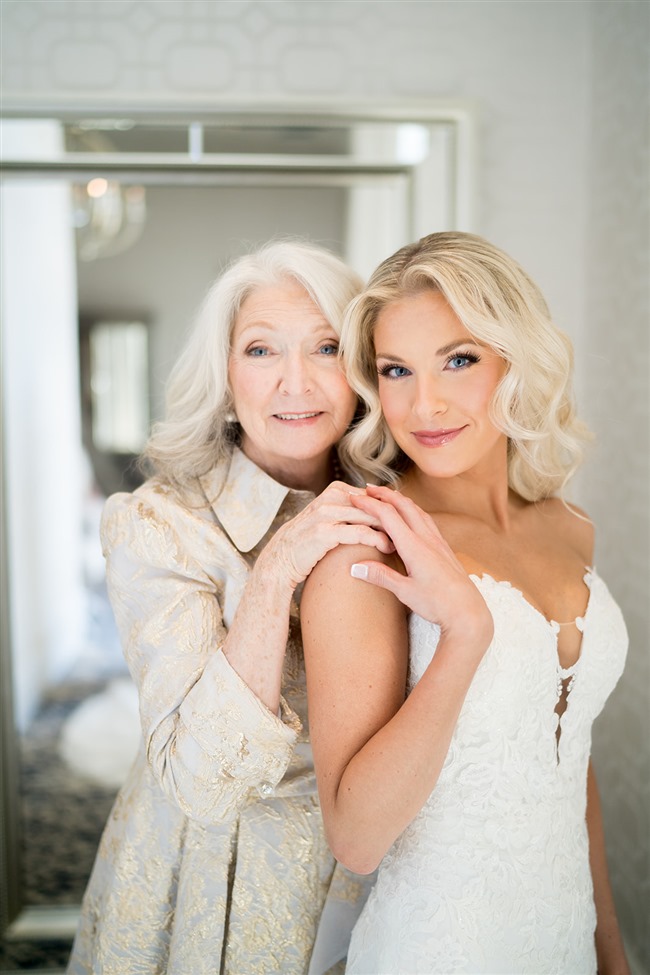
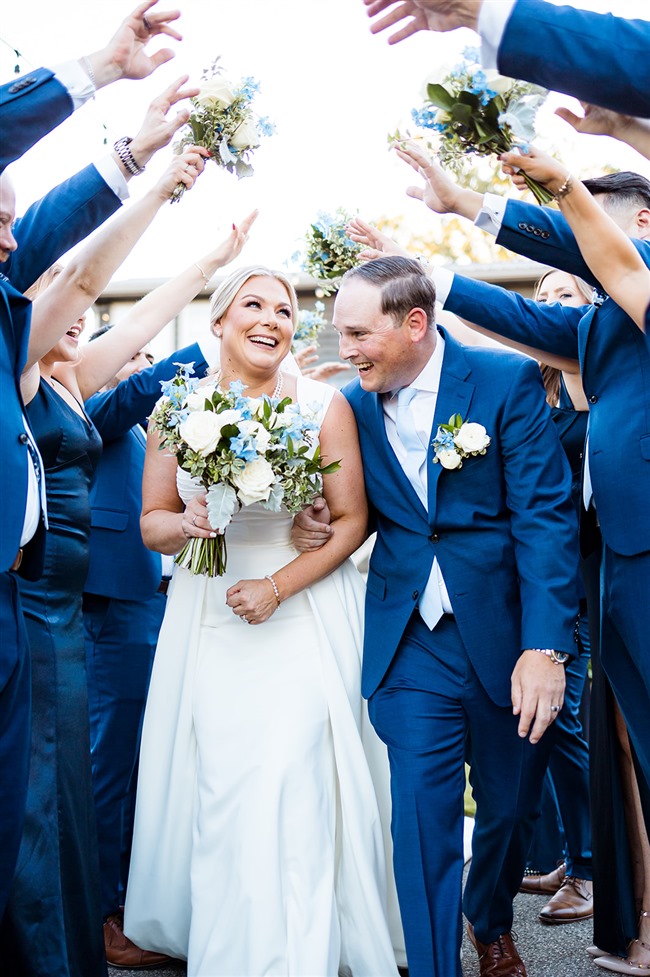
Think about mobility too. If a grandparent finds standing difficult, we’ll seat them and gather the family around them. A chair in the shade is a small thing that makes a big difference.
What if someone is missing?
Somebody won’t be there when we call, and yes, it happens at nearly every wedding. Don’t wait for them. We move on to the next grouping while the organizer tracks down the missing person. If they turn up in time, we add the photo at the end. If not, the reception is a good moment to photograph that person with you.
The short version
If you take one thing from all this: write the list, cap it near 15, name an organizer per side, ask each parent what they want, and give divorced parents their own groupings. If you’d like a hand building yours, we’re happy to. Every couple fills in our planning questionnaire, and we go through your timeline with you before the wedding. You can check your date at /#contactus, or see our packages at /investment.