Good news first: your outdoor Georgia wedding will probably be fine. Now the honest part, you still need a rain plan. Atlanta gets measurable rain on about 116 days a year, which is close to one day in three, so what really matters is if your plan B is one you’d be happy to stand in.
We’ve photographed a lot of wet weddings, and the pattern never really changes. The couples who enjoy their day are the ones who decided early what happens if it rains, then let the forecast play out. Below you’ll find the odds by month, a way to read the forecast, three levels of backup plan and what we do with the photos when the sky turns gray.
So what are the rain odds by month?
Here’s the data, and we’ll keep it plain. These are the 1991 to 2020 climate normals for Atlanta’s Hartsfield-Jackson airport. A “rain day” is any day with at least 0.01 inch of precipitation, so a short shower counts the same as an all-day soaker. The last column is ours, and the month shares come from our own 2024 to 2026 calendar.
| Month | Rain days | Inches | Our note |
|---|---|---|---|
| January | 11.1 | 4.59 | Few weddings (2% of ours). Cold rain, so windows and warm rooms matter. |
| February | 10.4 | 4.55 | Indoor-friendly portraits are the safer plan. |
| March | 10.5 | 4.68 | Spring storms start. Ask about covered space. |
| April | 8.9 | 3.81 | Popular (10% of ours). Keep a tent or porch in mind. |
| May | 9.4 | 3.56 | One of our busiest months (15%). |
| June | 11.1 | 4.54 | Afternoon storms are the main risk. |
| July | 12.0 | 4.75 | The wettest month. Plan for a short storm, not a lost day. |
| August | 10.2 | 4.30 | Storms and heat together. |
| September | 7.3 | 3.82 | Drier, but tropical remnants can reach Georgia. |
| October | 6.8 | 3.28 | The driest month, and our busiest (16%). |
| November | 7.9 | 3.98 | Dry and cool. A clear sky is likely, a cold one is certain. |
| December | 10.7 | 4.57 | Few weddings (4% of ours). Plan for rain and cold. |
What stands out is that the wettest and driest months are only about five rain days apart, so no month is safe and no month is hopeless.
Summer rain and winter rain aren’t the same
The season matters more than most people expect. A rainy summer day in Georgia is usually a short one. An Atlanta summer forecast often carries a daily chance of afternoon thunderstorms, and a storm can cool the air quickly and then move on. In our experience, those storms often leave a window of an hour or two before or after.
Cooler-season rain behaves differently. In our experience it tends to settle in for longer, and a gray, wet day is less likely to clear before the ceremony. Spring cold fronts can also bring strong storms, so a spring forecast deserves more than a glance at the little icon.
September has its own risk, too. Remnants of tropical storms have crossed Georgia in September before. The remnants of Hurricane Sally in 2020 brought widespread totals of 3 to 6 inches to north and central Georgia, and the remnants of Tropical Storm Lee in 2011 combined with a cold front to bring heavy rain. If your date is in September, ask your venue how it handles a really wet day, not just a drizzle.
How to read the forecast the week of your wedding
Please, stay off the weather app for a while. Don’t decide anything from a 10-day forecast. NOAA says a seven-day forecast is right about 80 percent of the time and a five-day forecast about 90 percent, while a forecast of 10 days or more is right only about half the time. Pop-up summer storms are the hardest thing to predict at that distance.
Here’s the simple rhythm we suggest. Ten days out, glance and move on. Five days out, start paying attention. Two days out, talk to your coordinator. The morning of, look at the radar, not the percentage. “40 percent chance of rain” means something very different on a day of scattered storms than on a day of steady rain.
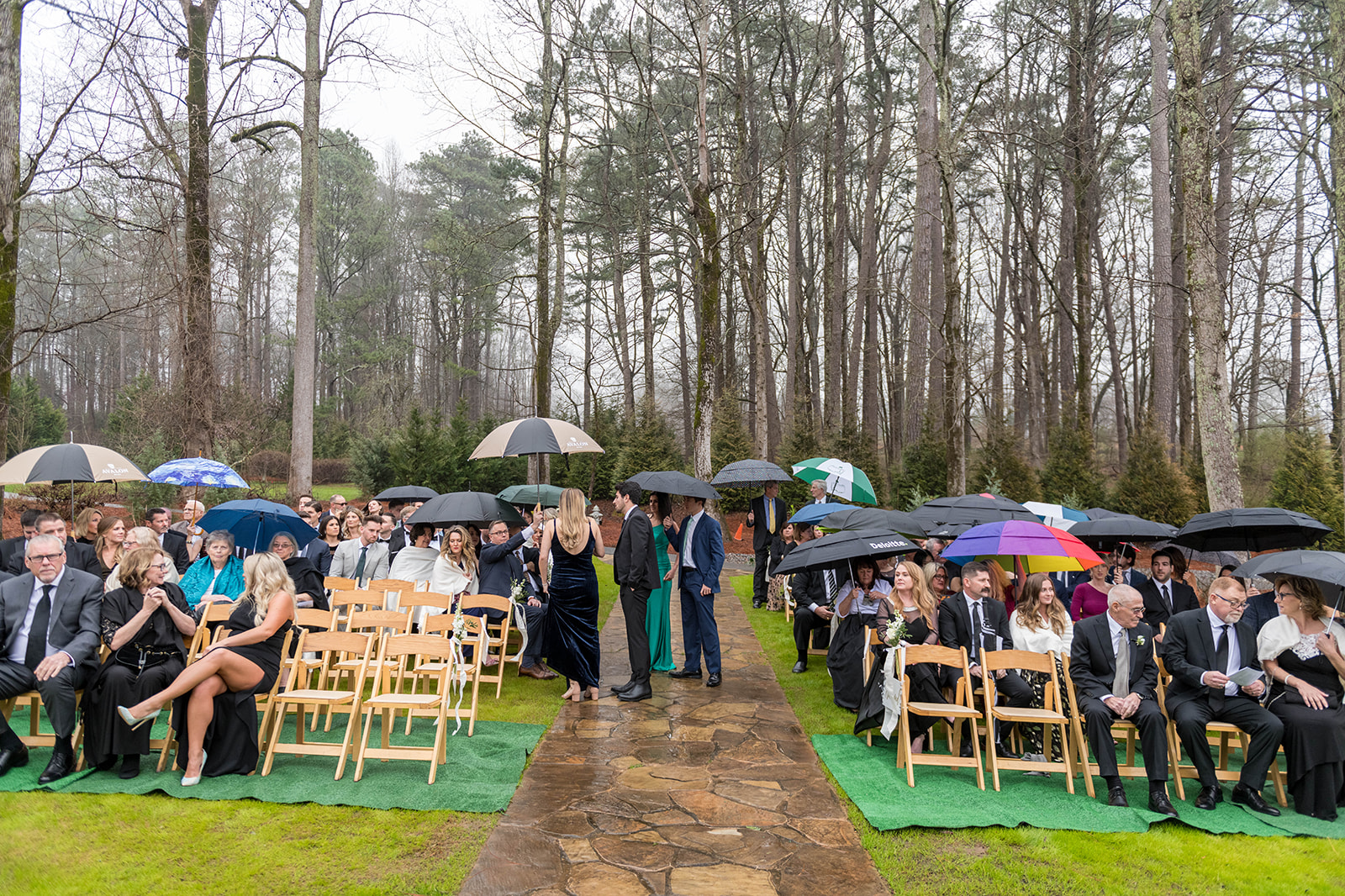
Our team’s notes from 212 weddings between 2024 and 2026 make a good reality check. Eighteen of them had rain or storms, and eight moved indoors. The other ten stayed outside, with umbrellas, covered space or a break in the weather. Rain changed the plan far more often than it ended it, which is worth remembering the next time you refresh the radar.
When to make the rain call
The rain call is the moment someone decides, officially, that it’s plan B. Long before the wedding, ask your venue and your coordinator two questions: what time is the rain call, and who makes it? Many venues decide the morning of the wedding, but the exact time varies, so get it in writing.
Then tell everyone. Your photographer, florist, DJ and caterer all need to know where the ceremony will be and when they’ll find out. A rain plan changes where we set up and how we pace the portraits, which is why we ask about it in the planning questionnaire.
Three tiers of plan B, from porch to indoor room
When we say plan B, here’s what we picture. Think of your backup in three levels, because each one changes how the day looks and feels.
Tier one, covered outdoor space. A porch, a pavilion, an overhang or a breezeway. You stay outside, guests stay dry and the light stays natural. It’s the easiest plan B to live with, and for photos it’s the closest to your original plan.
Tier two, a tent with sides and flooring. A tent keeps the rain off, but the sides and floor are what make it a real plan B. Without sidewalls, wind carries rain in. Without flooring, grass becomes mud. Tent light is soft and even, and a white tent works like a large diffuser for portraits. Ask about lighting, because a tent gets dark fast on a cloudy evening.
Tier three, an indoor room. The ceremony moves inside. It sounds the least romantic on paper and is often the most relaxed in practice, because everything’s dry and the schedule holds. Ask the venue for the room’s real capacity and where the light comes from. A room with tall windows photographs very differently from a room with none.
Most venues have one or two of these built in. Each of our venue guides has a rain plan section that describes what that venue offers, and it’s worth reading before you book, for example at Little River Farms or The Cowan Historic Mill.
What rain does to your portraits
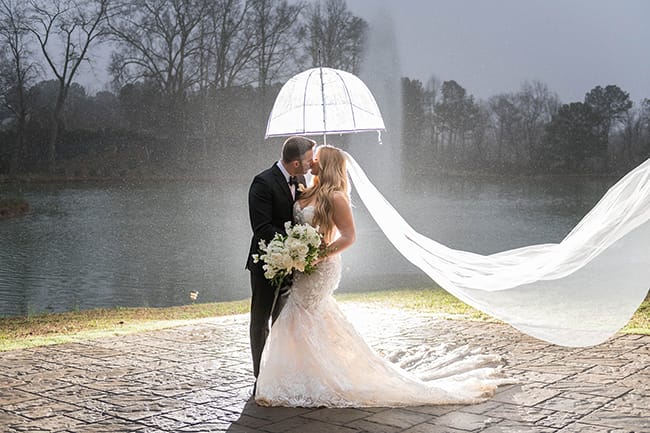
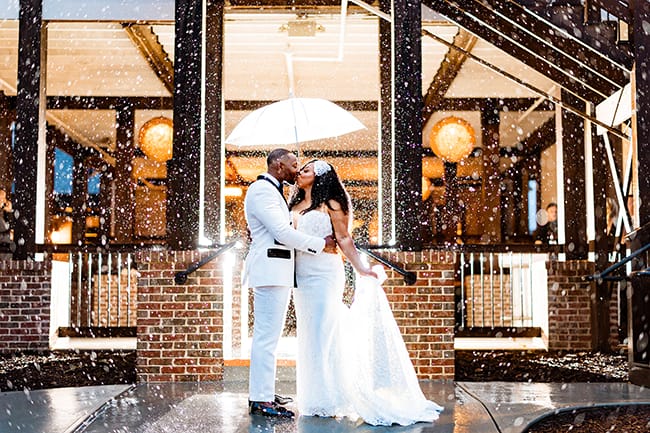
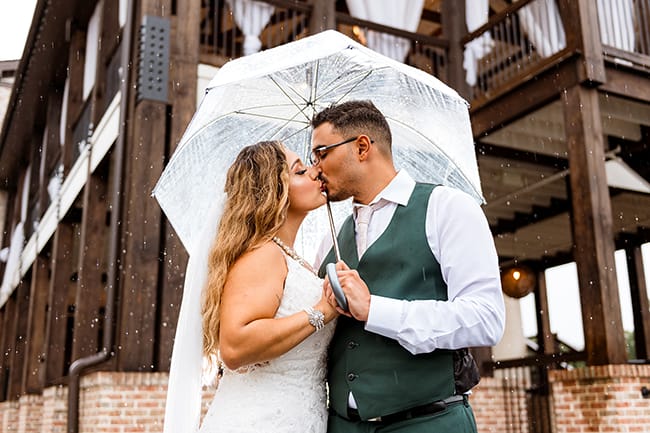
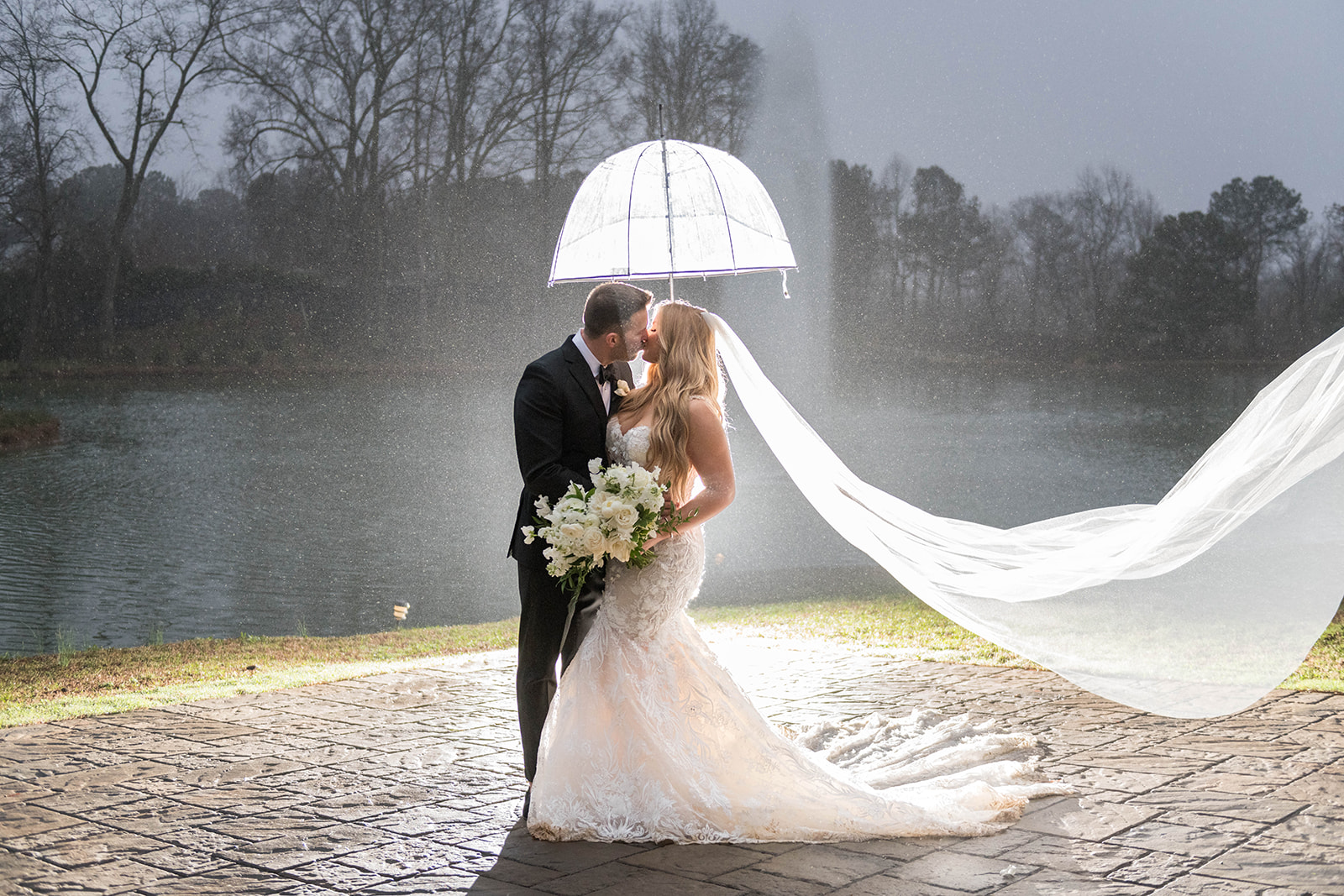
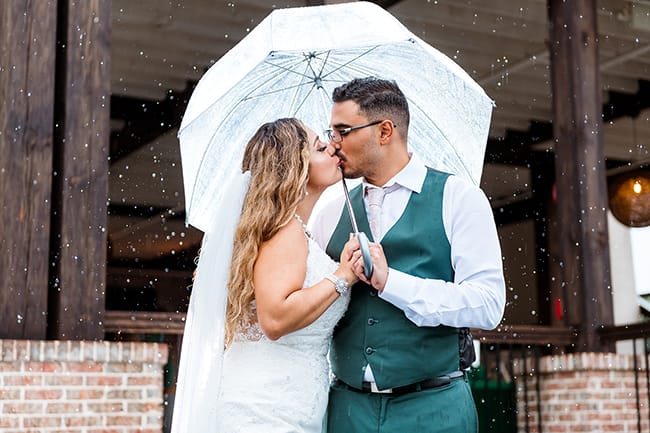
So, how do the photos actually turn out? This is where you’ll probably worry most, and where we worry least. Rain gives us things a sunny day doesn’t: reflections, clear umbrellas, soft light with no squinting and a mood that’s hard to copy.
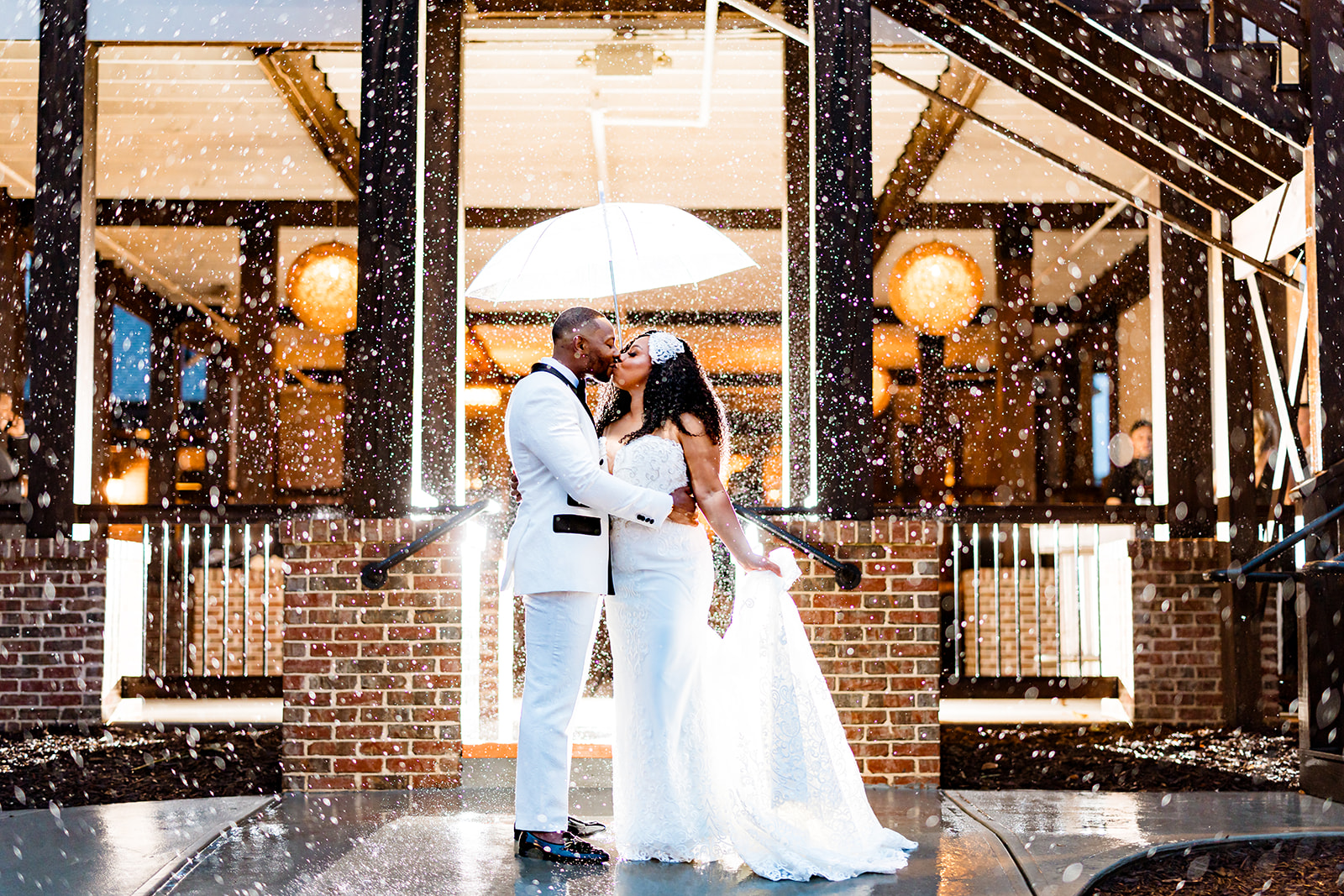
Here’s how we usually approach a wet day.
- Clear umbrellas. They keep faces and hair visible and let the light through. Have two or three on hand.
- A covered porch or doorway. Even a few feet of overhang gives us a dry frame for portraits.
- A break in the weather. One couple in our notes skipped nothing: they used a short break between storms and went out at once. Keep a shoe change and a towel handy so you can go the minute it clears.
- Windows. Big window light is flattering, and a rainy day makes it softer still.
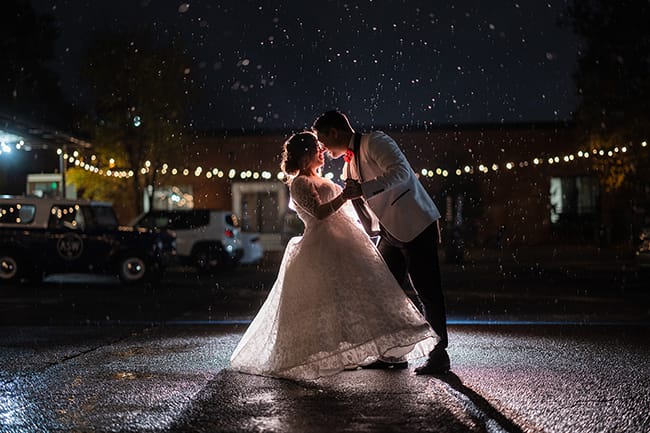
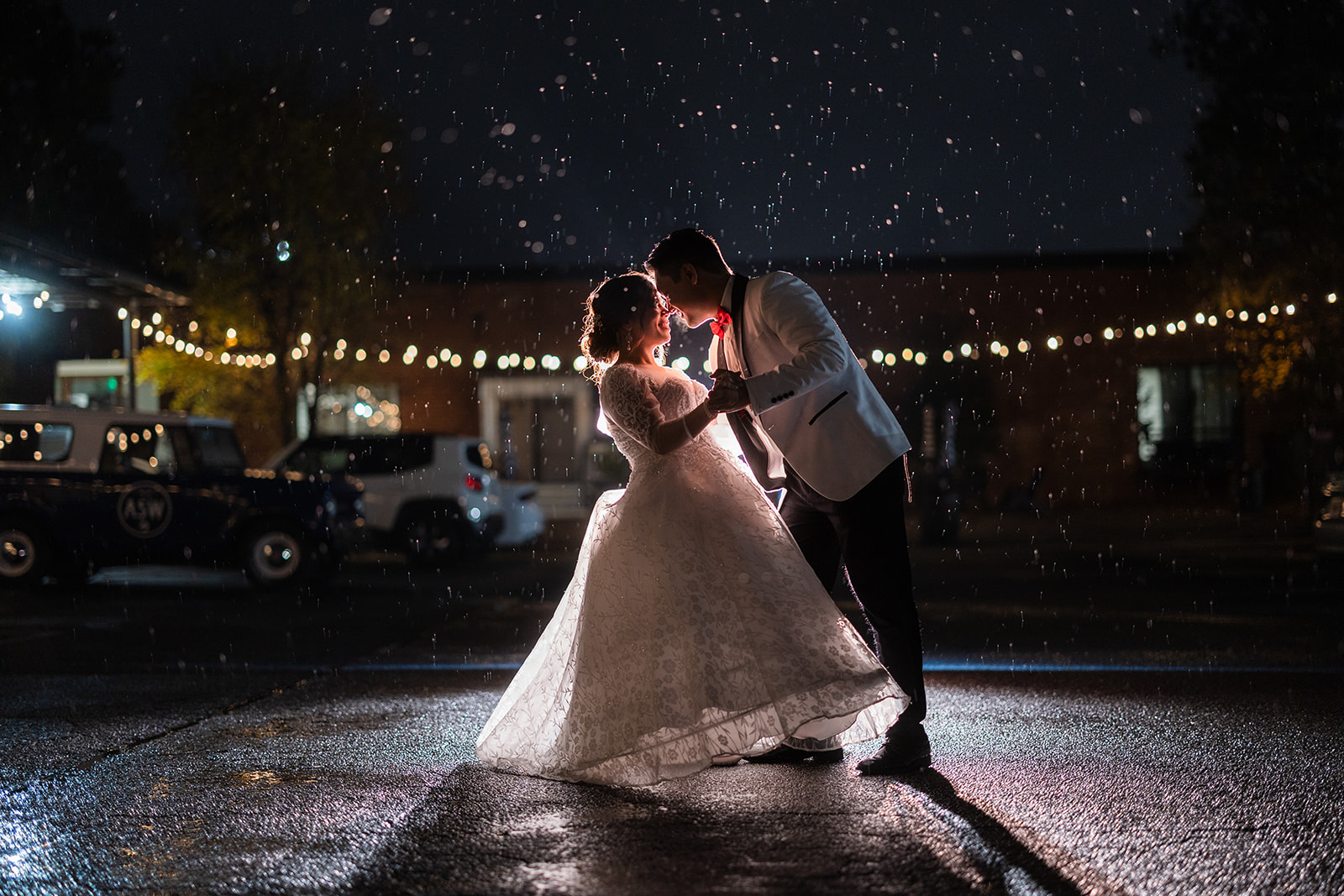
- Night rain. A wet night can look dramatic. With our Moonlite lighting system, we can shoot in the dark and still keep the couple lit and the rain visible.
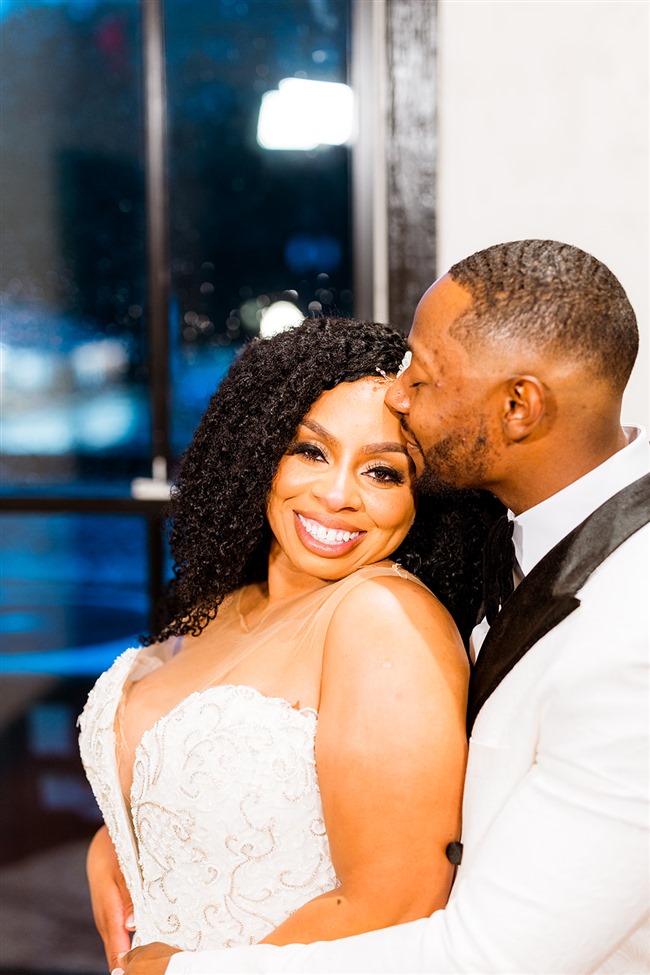
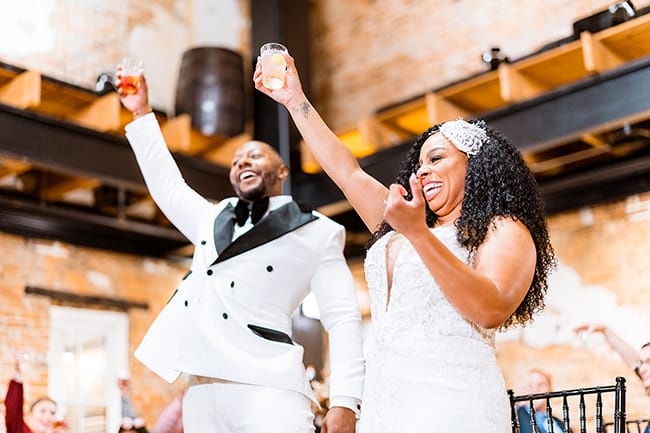
Rain rarely ends a wedding. It changes where we stand and how the light falls.
What to buy and bring for a rainy day
You don’t need much. A small kit is cheaper than a worry. Put it all in a box with a name on it and hand it to a bridesmaid or your coordinator.
- Clear umbrellas for the couple, and plain ones for guests at the door
- Towels, for faces, chairs and shoes
- A second pair of shoes for the bride, and a pair of old ones for the walk across the lawn
- Tent sidewalls and flooring, if you have a tent
- A garment bag or plastic cover for the dress between locations
- Hair spray and a few extra pins
Keeping your guests comfortable
A quick word about the people you invited. Your guests will remember being cold and wet. Put umbrellas at the door, give coats a dry place and keep the ceremony short. If the plan changes that morning, a text or a sign at the entrance saves a lot of confusion.
Heat deserves the same attention, too. In our notes, 18 weddings had serious heat, and in seven of them the couple cut portraits or night shots. Water, shade and a shorter schedule are the same kind of plan B.
Let go of the weather
Once the plan is made, let it go. Having a rain plan isn’t pessimism, it’s the thing that lets you finally stop checking the radar and start enjoying the week.
The couples who look happiest in their photos usually aren’t the ones who got the weather they wanted. They’re the ones who decided to enjoy whatever showed up.
If you’d like to talk through a plan B for your date, check your date with us and we’ll go through it together. And to see where rain fits into the schedule, our timeline for a 4 PM ceremony is a good next read.